Tennis doubles rules: serving, scoring, boundaries.
The rules that actually come up in a club doubles match — serving and receiving order, when the alley is in play, how scoring works, and what to do when the score is disputed. For league players and organisers.
Try Grex Social freeThe reference
Five things to know.
Doubles uses the same scoring and the same service motion as singles — the differences that actually come up in a club match are the wider court, the four-player serving rotation, and the receiving-side rule that locks you to one side for the whole set. The ITF rules below are what you follow when the ball is in play; your club's playing rules decide the shape of the match.
- Four players, two per side — simple on paper; the positioning and partner-coordination nuance is where club doubles actually gets interesting.
- The alley (tramlines) is IN for doubles, OUT for singles — the single most-asked rule, and the one that trips up players moving between formats.
- Serving order is fixed for the set — each team picks who serves first, and the four-player rotation then repeats every game until the set ends.
- Scoring is identical to singles — 15, 30, 40, deuce, advantage, with a tie-break at 6-6. The format of the match is what varies, not the point count.
- Local club rules sit on top of the ITF rules — this page covers official ITF / LTA play; your organiser's playing rules decide the shape of the match.
The rules, one by one.
Four areas that cover almost every rules question that comes up in a club doubles match. For specific numeric rules not spelled out here, see the ITF Rules of Tennis or the LTA Rules of the Game.
01 — Serving and receiving
pick an order, then stick to it for the set.
Each team chooses which player serves first for the set; the four-player rotation then repeats every game. Receiving sides (deuce court / ad court) are also chosen at the start of the set and stay fixed. You can change both at the start of the next set but not mid-set. See ITF Rules 14 and 15.
- A1 serves game 1, B1 game 2, A2 game 3, B2 game 4, repeat
- Receiving sides fixed for the whole set
- Both can be changed at the start of the next set
02 — Court boundaries
tramlines in; service box unchanged.
The doubles court is 36 feet wide — the full width including both tramlines (the alleys). The singles court is 27 feet wide, using the inner sidelines only. The service box dimensions are the same in both formats, so the serve itself targets the same box — only the rally boundaries widen.
- Doubles court: 36 ft wide (tramlines in)
- Singles court: 27 ft wide (inner sidelines only)
- Service box is identical in both formats
03 — Scoring
same as singles; format varies by club.
Points go 15, 30, 40, deuce, advantage, game. Sets are first to 6 games with a two-game margin; at 6-6 a tie-break is played to 7 by 2. Club matches are typically best-of-3 sets, with a first-to-10-by-2 match-tiebreak commonly substituted for the third set when time is short. No-ad scoring (sudden-death at deuce) is another common shortening — the receiving team chooses which side returns the deciding point.
- 15, 30, 40, deuce, advantage — identical to singles
- Sets first to 6 with a 2-game margin, tie-break at 6-6
- Match-tiebreak (first to 10 by 2) often replaces a third set at club level
- No-ad scoring: single sudden-death point at deuce; receiver chooses side
04 — Disputes and result confirmation
call your own lines; replay disputed points.
At club level there's no umpire, so players call their own lines. Either player on the receiving team can make a call, and the standard practice is 'if in doubt, call it in'. When the two sides disagree on the score — not an uncommon event in a long rally — the standard club resolution is to replay the point from the last agreed score. For league events, organisers can resolve persistent disputes retrospectively; on Grex Social the opponent-dispute flow routes those to the organiser's admin screen.
- Either receiving player can call the line
- 'If in doubt, call it in' — benefit of the doubt to the striker
- Score disputes: replay the point from the last agreed score
- Organiser dispute resolution via Grex Social's admin screen for league events
For a club running a summer competition on top of these rules, see the summer tennis tournament guide for format, draw and scheduling patterns.
For organisers
What Grex Social gives you for doubles.
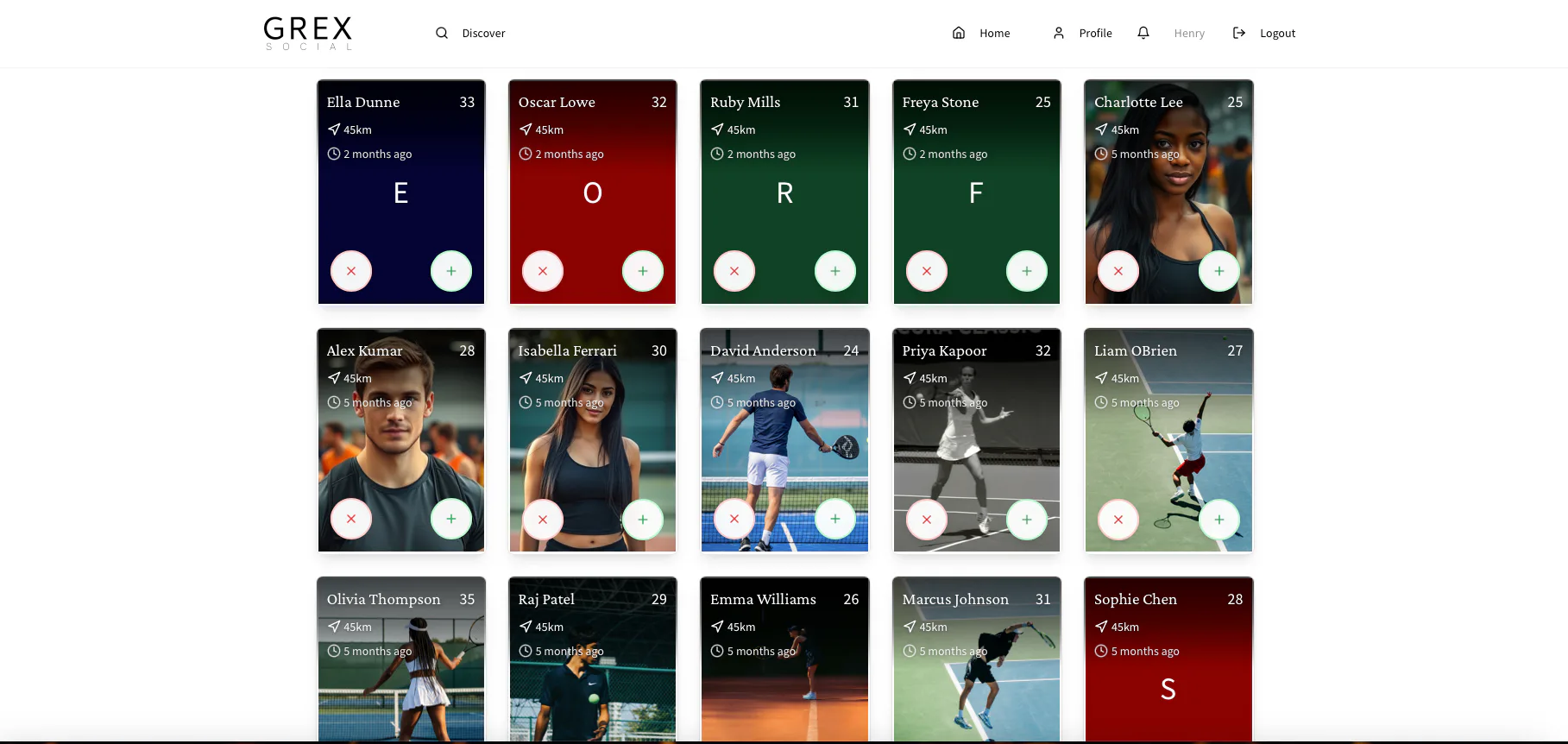
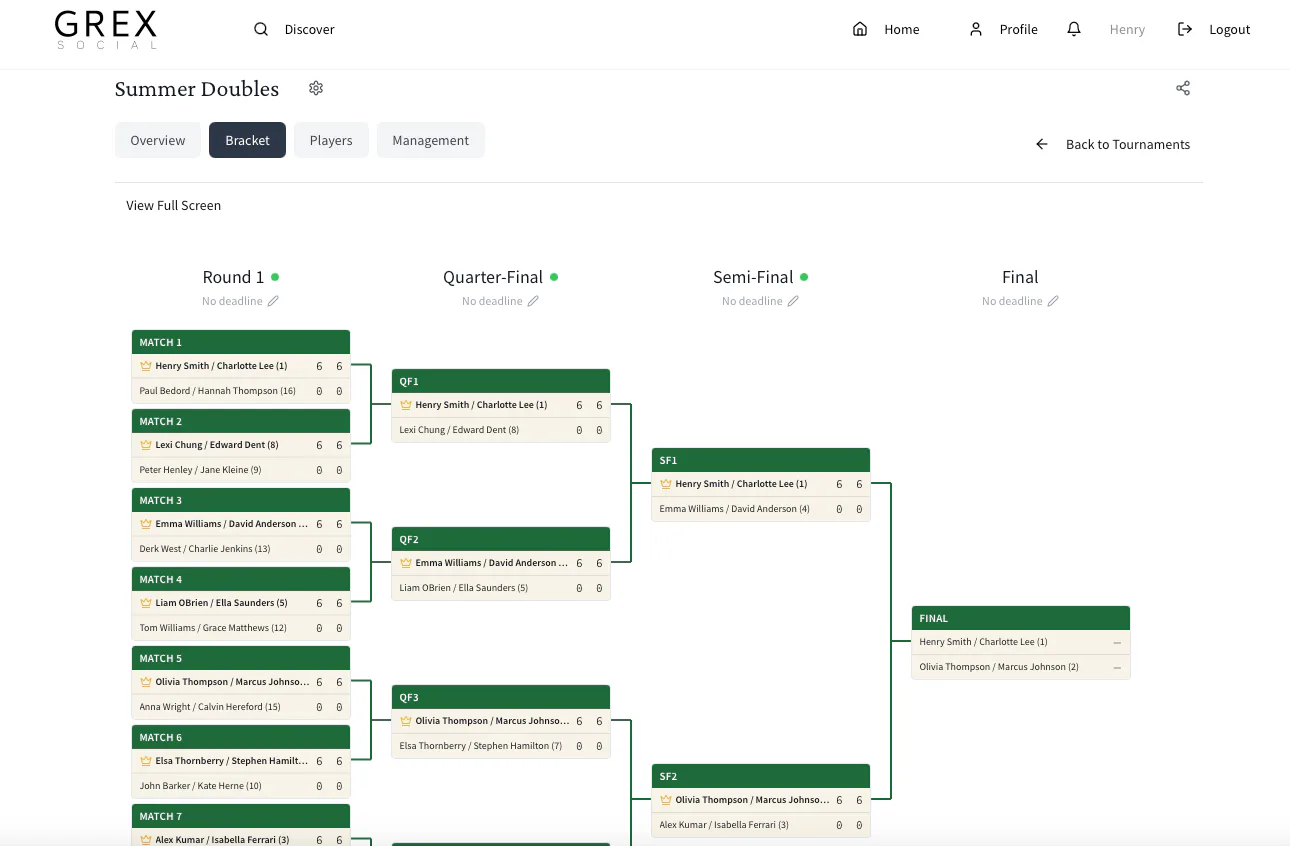
Grex Social doesn't officiate matches — players call their own lines and agree the score. What we do is run the competition around the match: entries, pairings, score confirmation, standings and payments.
- Doubles entries in every competition type — box leagues, ladders, team cups and tournaments all run singles or doubles side by side.
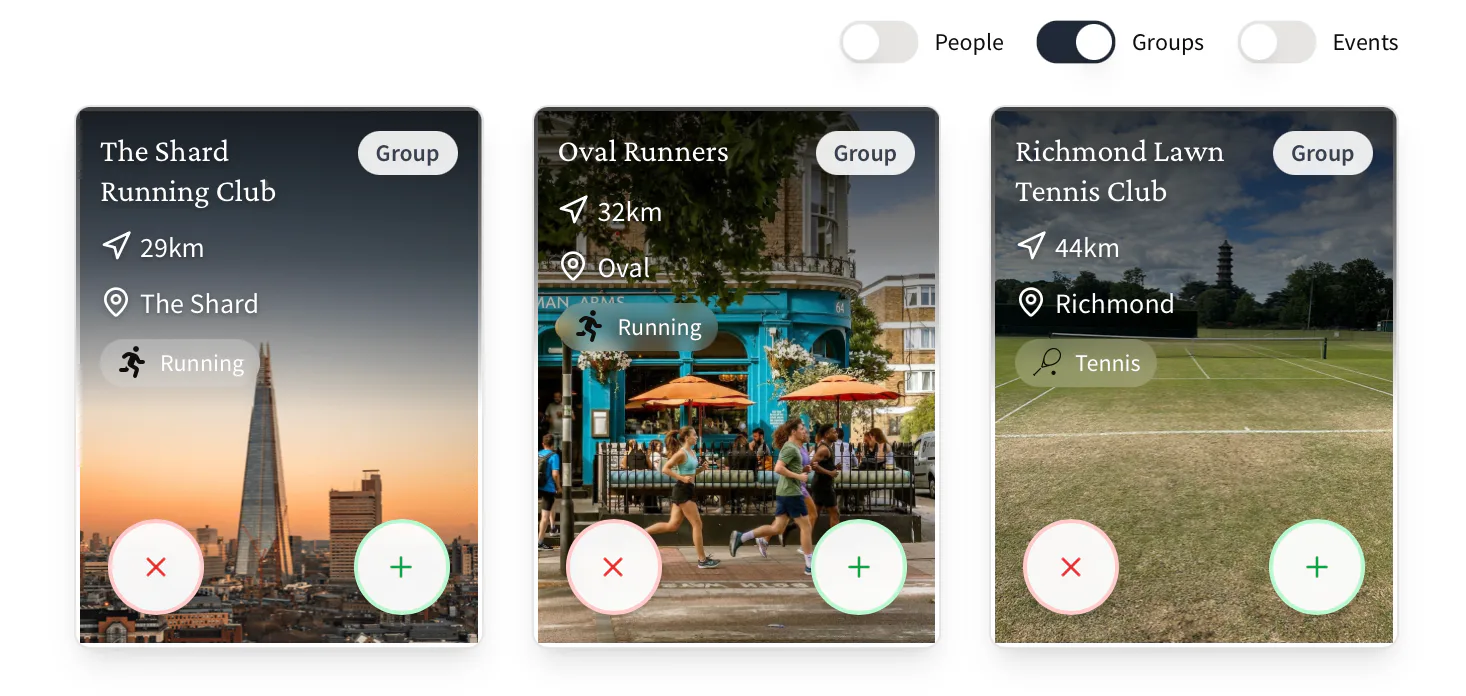
- Pair signups with a 'find me a partner' flag — enter as a fixed pair, or as an individual looking for a partner. Organisers see both lists in one view.
- Score entry from the court — one player enters the result on their phone; the opposing pair confirms with a single tap. No paper scoresheets to transcribe.
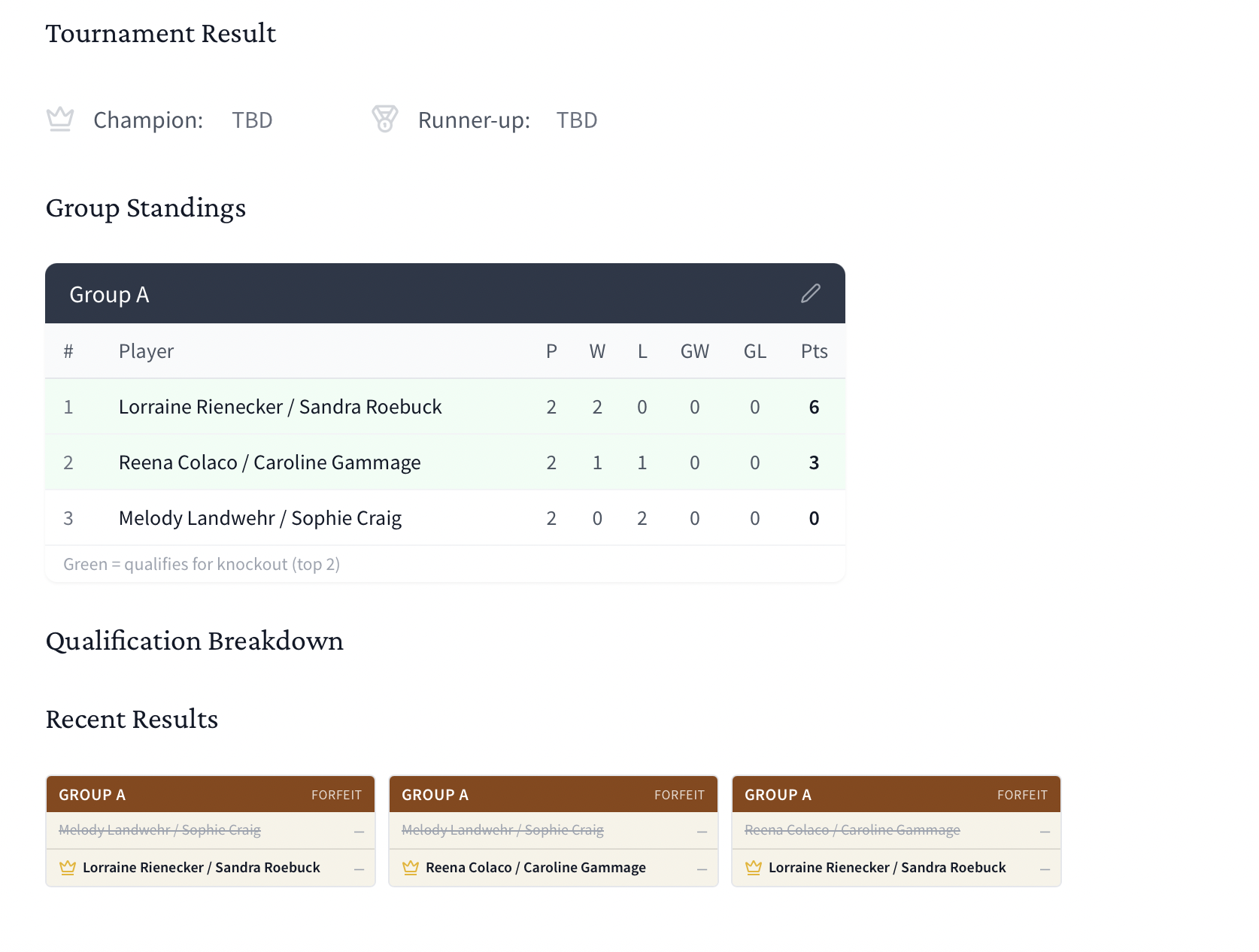
- Automatic standings update — the table refreshes the moment a result is confirmed. No end-of-week recalculation.
- Mixed-doubles support — filter pairs by gender mix when the event requires it (e.g. mixed-only tournaments or mixed box leagues).
- Automated reminders for upcoming fixtures — email and in-app push so pairs don't miss a scheduled match.
- In-app Stripe entry-fee collection — pair entry fees paid once at signup, straight to the club's bank account. No cash on the night.
- Opponent dispute flow — either player can flag a score; the organiser resolves from one admin screen rather than from the group chat.
- Free for players; £39-£69/mo for clubs — the Club plan covers unlimited doubles competitions plus the rest of Grex Social.
- Works alongside your internal club playing rules — organisers can override tie-break format, no-ad scoring, sets to play, so the on-court rules match your night.
- Americano, Mexicano and King of the Court — social doubles formats on the same engine, for mixed-ability nights that don't need a formal draw.
- Match history and head-to-head records — every player keeps a full doubles record, useful for seeding the next season or settling tiebreakers.
FAQ
Common questions.
Is the alley in or out in doubles tennis?
The alley (tramlines) is IN for doubles and OUT for singles. The doubles court is 36 feet wide — the full court including both tramlines. The singles court is 27 feet wide — the inner two sidelines only. The baseline, net height and service boxes are unchanged between formats; only the sidelines move. This is the single most-asked tennis doubles rule because the same lines are painted for both games on a club court.
What is the serving order in doubles?
Each team picks its serving order at the start of each set. If team A chooses player A1 and team B chooses player B1, the rotation is: A1 serves game 1, B1 serves game 2, A2 serves game 3, B2 serves game 4, then back to A1 for game 5. The order is fixed for the whole set — you can't rotate within a set, only at the start of the next set. See ITF Rule 14 for the official statement.
Can you change the receiving order mid-set?
No. Each team picks who returns in the deuce court (right side) and who returns in the ad court (left side) at the start of the set, and that order is fixed until the set ends. You can swap at the start of the next set but not within one. If a player returns from the wrong side by mistake, the point stands and the receivers must correct the order at the next return — see ITF Rule 15.
How is doubles scored?
Identically to singles. Points go 0 (love), 15, 30, 40, then game. A 40-40 score is deuce; the next point is advantage to whoever won it, and the following point is either game (if the same team wins again) or back to deuce. A set is first to 6 games with a two-game lead; at 6-6 you play a tie-break (first to 7 points, win by 2). Most club matches are best-of-3 sets, with a third-set match-tiebreak common at club level.
What is a match tiebreak?
A match tiebreak is a first-to-10-points-by-2 tiebreak played instead of a full third set. It's the standard club-level substitute when a match is level at one set all and there isn't time for a full decider. ITF rules allow it and it's the default in LTA-sanctioned club events like Team Tennis. Grex Social lets organisers set match-tiebreak as the deciding-set format per competition.
Do both players have to call lines?
No. Either player on the receiving team can make a line call, and the call stands unless the opposing team disputes it. In practice the player closest to the line usually makes the call. The standard club etiquette, codified in LTA guidance and the ITF Code of Conduct, is 'if in doubt, call it in' — the benefit of the doubt goes to the striker.
What happens when you can't agree on a score?
At club level — where there's no umpire — the standard practice is to replay the point. If the two teams genuinely remember the score differently, the fair outcome is to go back to the last agreed score and continue. Many club leagues also allow the organiser to resolve persistent disputes retrospectively; on Grex Social the dispute flow lets either player flag the result and the organiser decides from the admin screen.
Do club doubles use the same rules as professional doubles?
The in-play rules (serving, scoring, boundaries, line-call etiquette) are the same. The match format usually isn't — club events shorten the match to fit a fixed-length evening. Common club shortenings: match-tiebreak replaces the third set, no-ad scoring replaces advantage sets, or two short sets of first-to-4 games. ATP / WTA doubles is still best-of-3 full sets at most tour events. Your club's playing rules decide which shortenings apply.
What's no-ad scoring?
No-ad scoring is a sudden-death point at deuce — instead of needing to win two points in a row from 40-40, the next point decides the game. In doubles, the receiving team chooses which side returns the sudden-death point. No-ad is common in US college tennis, LTA Team Tennis and most club evening leagues because it caps the maximum length of a game and makes rounds predictable.
How does Grex Social handle doubles entries and scoring?
Doubles entries work the same across all competition types — pairs sign up together, or individuals sign up with a 'find me a partner' flag. Score entry is from any phone during the match, with opponent confirmation in one tap and automatic standings updates. See the box league guide and the club ladder guide for the two most common doubles formats, and the tennis clubs directory for clubs already running competitions on Grex Social.
Where can I find the official tennis rules?
The authoritative sources are the ITF Rules of Tennis (official playing rules used worldwide) and the LTA Rules of the Game (UK-specific supplements and sanctioning rules). Grex Social's role is organising matches and recording agreed results — we don't officiate, and we don't substitute for the rulebook. For specific numeric rules, defer to the ITF or LTA documents.
Ready to run your club doubles competitions?
Free for players; 30-day free trial on the Club plan. Box leagues, ladders, team cups and tournaments all run doubles out of the box.