Mexicano padel: rules, format, how to run one.
Social padel that stays competitive. Partners rotate every round, and players re-group between courts by score — so every match is at your level, all night.
Try Grex Social freeThe 30-second version
Five things to know.
Mexicano is the format for clubs that want social padel to stay a real match. Partners rotate every round, and after every round the whole field is re-sorted by score — top players on Court 1, next best on Court 2, and so on. You get Americano's social variety with tournament-style level balance.
- Re-grouped by score every round — top scorers meet top scorers on Court 1, next-best on Court 2, and so on. Matches stay close all night.
- Partners still rotate — each round pairs you with a new partner within your court, so you never sit out with the same player twice.
- Individual scoring — every player carries their own point total across rounds. Highest individual total wins the night.
- Best for mixed-ability groups who want it competitive — Mexicano's re-grouping mechanism means everyone plays at their level after round 1, unlike Americano's random mix.
- Needs at least two courts — one court is Americano, two or more is Mexicano. Four courts (16 players) is the sweet spot.
How to run a Mexicano night.
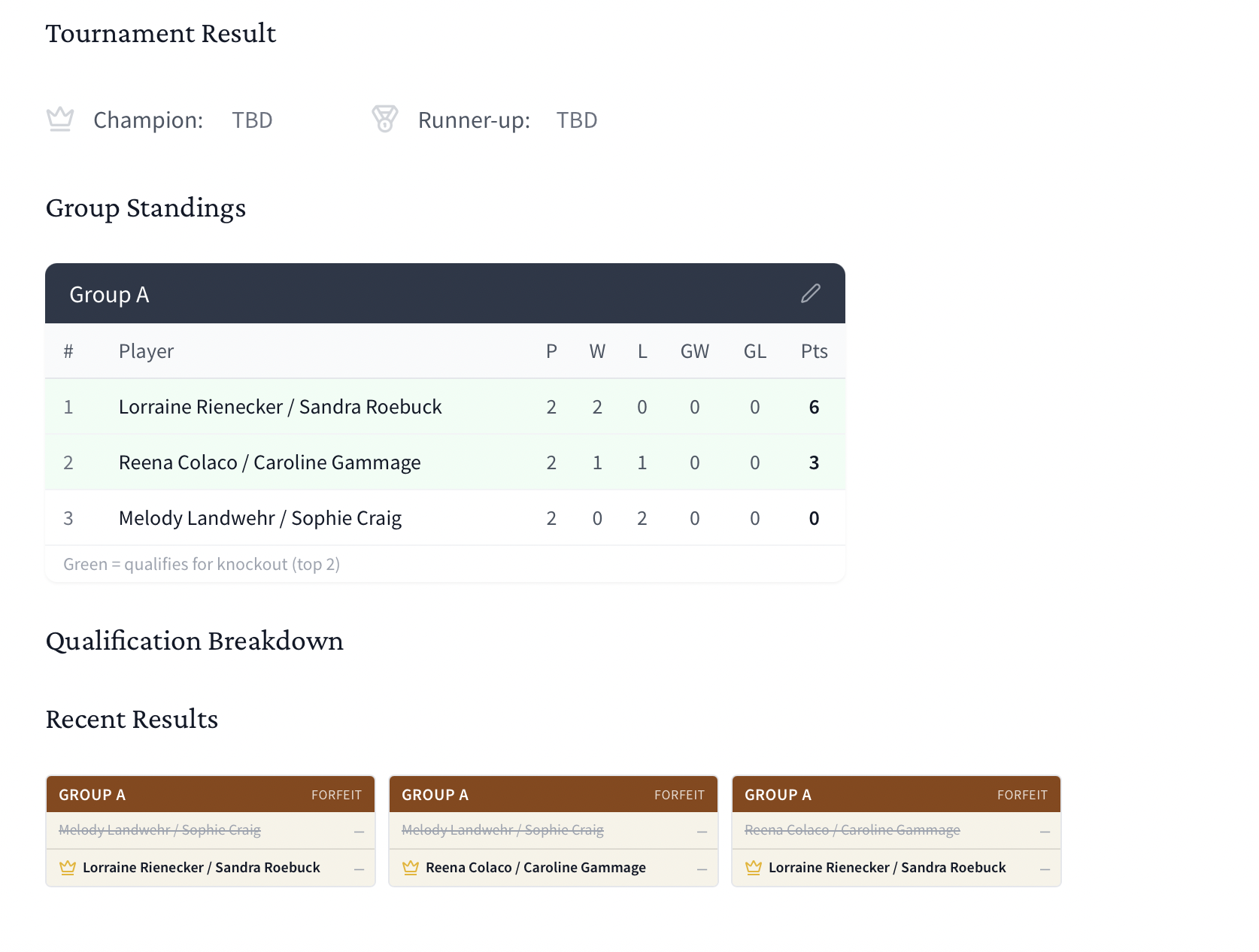
01 — Pick the format + round rules
point target, court count, round count.
Confirm how many courts you'll use (Mexicano needs at least two), how each round ends (point target is standard — first to 24 or 32), and how many rounds fit in the night. A typical 2-hour club night runs 6–8 rounds of ~12 minutes each. Grex Social handles all three settings in the event setup.
- At least two courts (8 players); ideal is 4 courts (16 players)
- Point target (24 or 32) keeps round length predictable
- 6-8 rounds fits a standard 2-hour club night
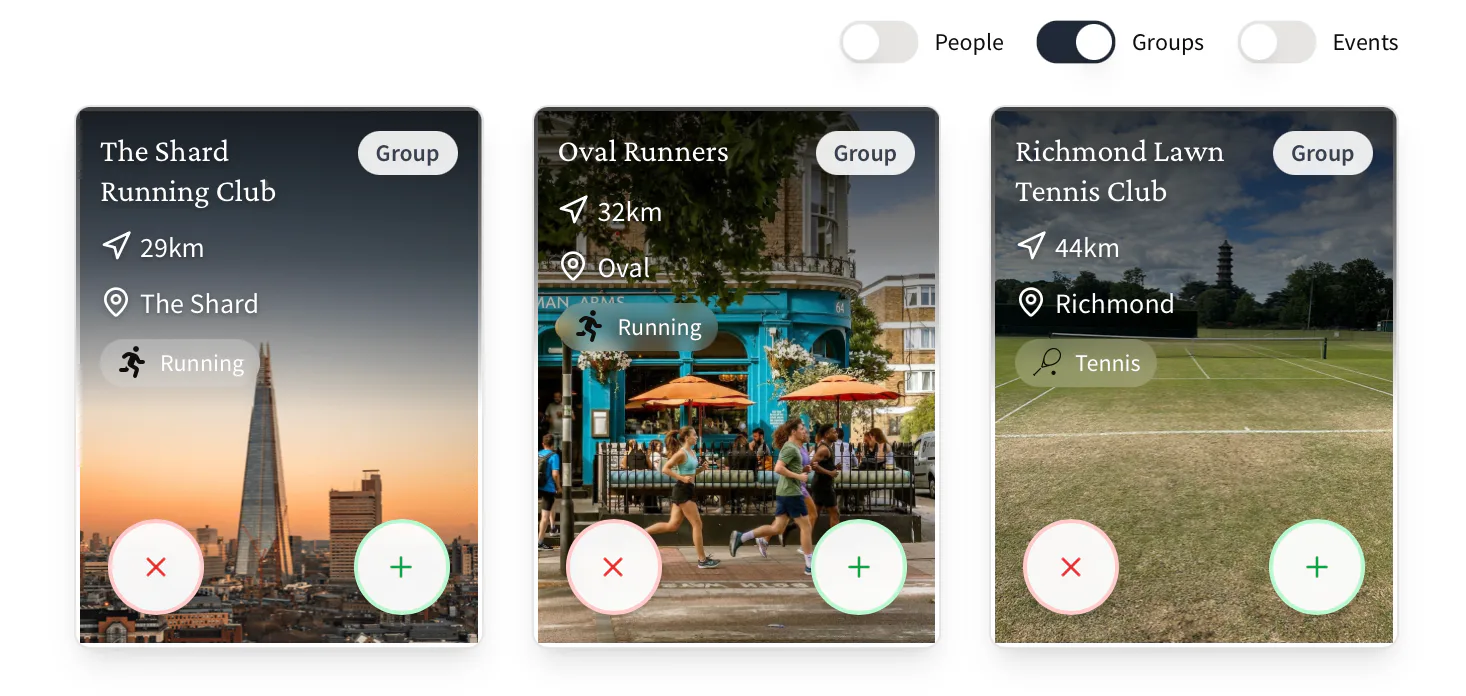
02 — Open signups, take entry fees
members and guests, paid in-app.
Open the event to members and (optionally) guests. Set the entry fee (typically £5-£10 per player) and Grex Social collects it via Stripe direct to the club's bank. No cash handling on the night, no reconciliation afterwards. Automatic waitlist if the night fills.
- Signup opens to members and guests
- In-app Stripe entry-fee collection
- Automatic waitlist plus late-drop handling
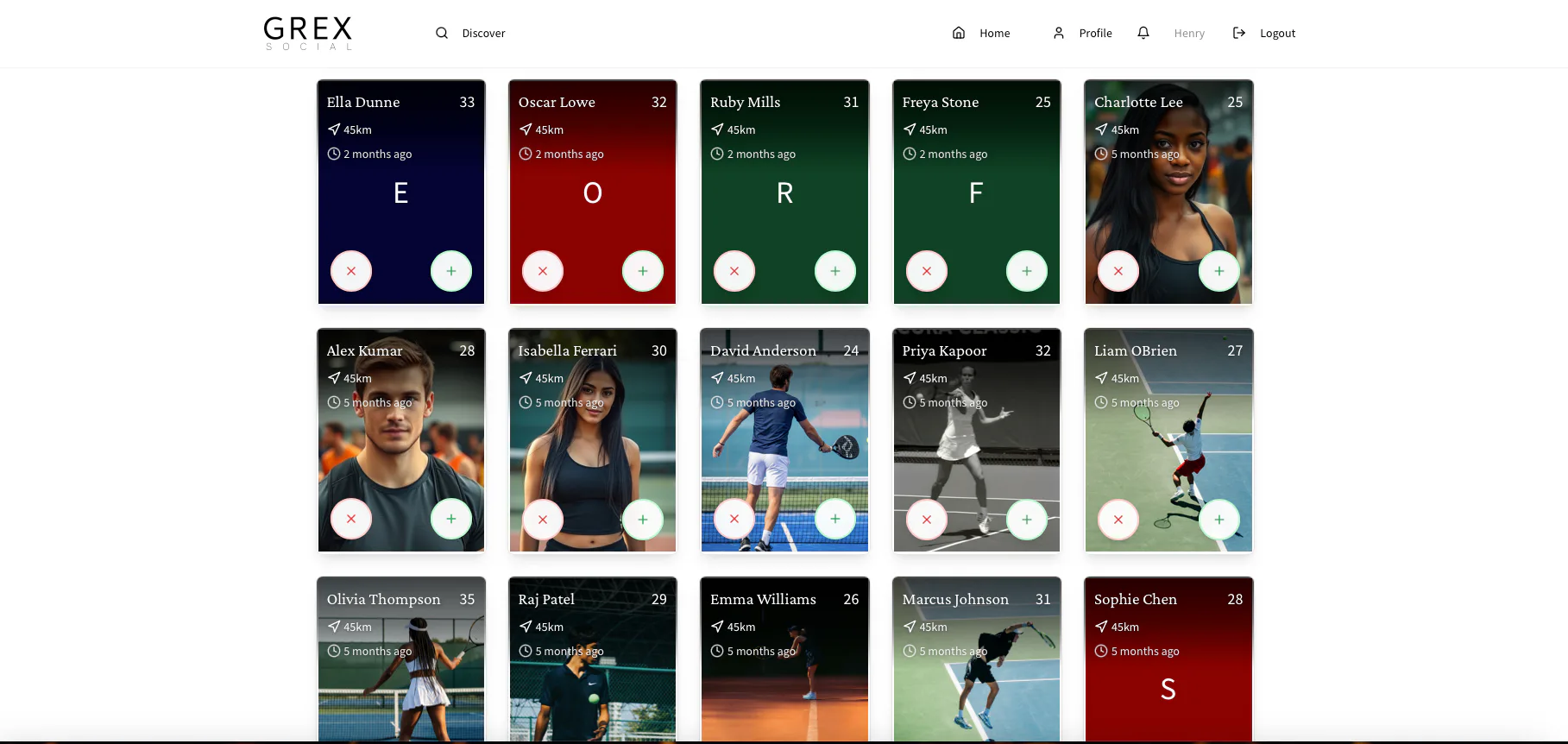
03 — Round 1: seed, then let it run
random seeding, partners rotate within court.
Round 1 is randomly seeded — no one has a leaderboard position yet, so the initial courts are drawn from the signup list. From round 2 onwards, the re-grouping takes over. Within each court, partners rotate every round, so even players on the same court don't play with the same partner twice.
- Round 1 randomly seeded across courts
- Partners rotate within court, round by round
- Score entry from the court, opponent confirmation is one tap
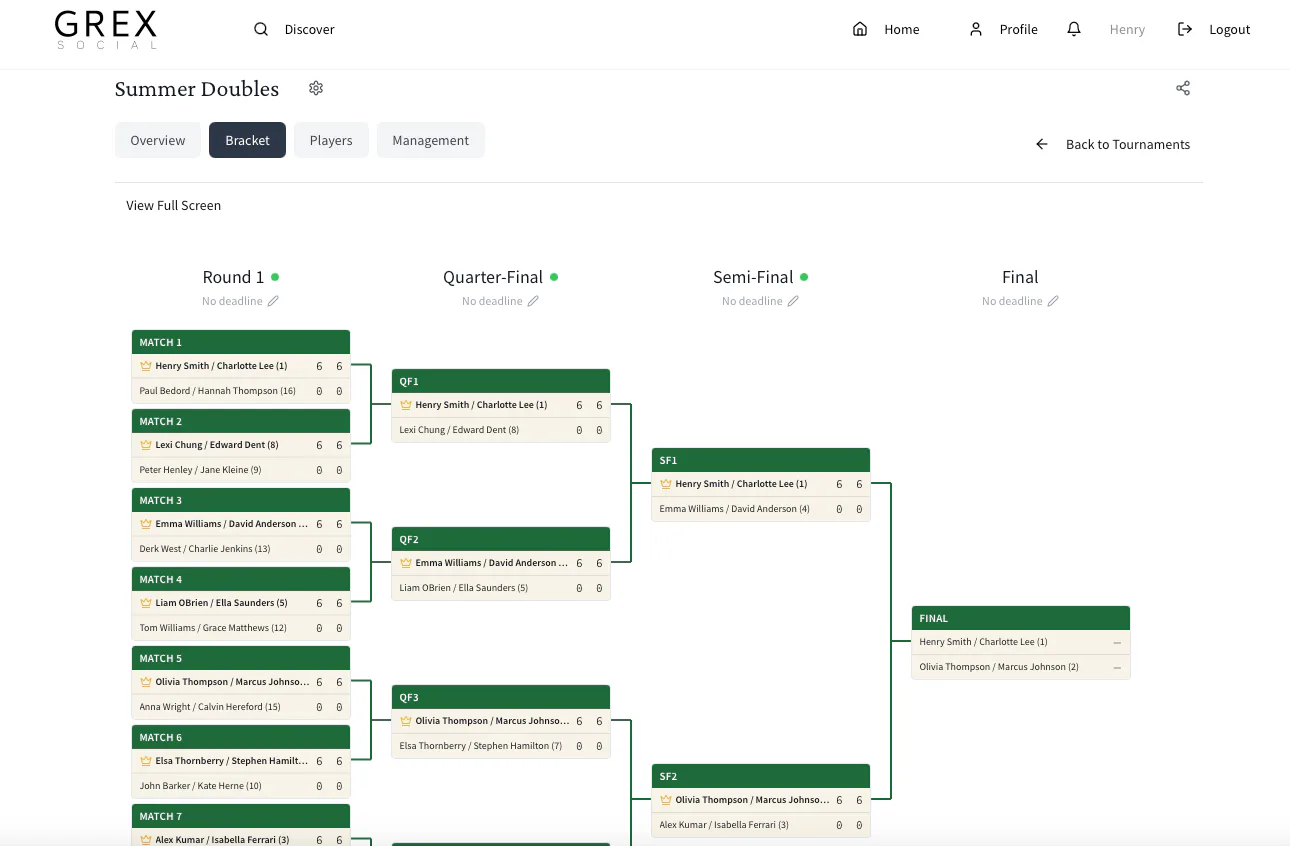
04 — Re-group between rounds
leaderboard decides the next court.
This is Mexicano's defining move and the fiddly bit that kills it on paper. After every round, Grex Social sorts the whole field by total individual points and re-seats players: top 4 to Court 1, next 4 to Court 2, and so on. Players see their new court on their phone before they've walked off the previous one. No whiteboard, no organiser pause.
- Auto re-grouping every round based on live standings
- Players see their next-round court in-app before they leave
- Fair sit-out rotation for uneven signups
- Final leaderboard published to all players at end of night
Under the hood
What Grex Social gives you.
- Automatic court re-grouping — after every round Grex Social sorts players by their current total and re-seats them across courts. No manual whiteboard.
- Partner rotation within court — inside each court, partnerships still rotate so it stays social within the competitive framing.
- Live individual leaderboard — a single ranking updates the moment round scores are entered, so players see where they'll be seated for the next round in real time.
- Configurable round targets — set the round to end at a point target (24 or 32), a game target, or a time limit. Same engine as Americano; switch per event.
- Handles 8 to 32 players across 2–8 courts — scales from a small club night to a bigger tournament-style Mexicano.
- Fair sit-out rotation for uneven numbers — if you're not on an exact multiple of 4, Grex Social rotates the sit-out fairly so no one loses more rounds than anyone else.
- Score entry from the court — winner enters, opponent confirms in a tap. No organiser transcribing paper scores between rounds.
- Runs alongside Americano and King of the Court — same event engine covers all three padel social formats; switch between them per event.
- In-app Stripe payments — collect entry fees (typically £5-£10 per player) direct to the club's bank account.
- Reminder push and email — on the day and an hour before, so the field stays full.
- Rolling series scoring — link a season of Mexicano nights into a Championship so a regular gets a season-total ranking, not just single-night results.
- Free for players, £39-£69/mo for clubs — the Club plan covers Mexicano plus every other Grex Social competition.
FAQ
Common questions.
What is Mexicano padel?
Mexicano is a social padel format where players rotate partners every round (like Americano) AND get re-grouped between courts based on their current score. After each round, the leaderboard is updated: the top four go to Court 1, the next four to Court 2, and so on. Partners still rotate within a court, so everyone plays with new people, but you're always matched with players at your current level. It's the format's biggest draw for clubs that want the social feel of Americano without the mixed-level pairings.
How is Mexicano padel different from Americano?
Americano rotates partners round-by-round but keeps players on the same court all night — you play whoever you're paired with regardless of skill. Mexicano rotates partners AND re-groups players by score after each round. The result: in Americano, a strong player and a beginner might end up partnered mid-round; in Mexicano, you always play at your current level. Americano is purely social; Mexicano is social-plus-competitive. Grex Social supports both formats on the same engine — switch per event.
How many players do you need for Mexicano?
You need at least two courts for Mexicano to work — the format's whole point is re-grouping between courts. Two courts (8 players) is the minimum; four courts (16 players) is the sweet spot; up to eight courts (32 players) scales well. With only one court and 4 players, Mexicano collapses into Americano because there's nowhere to re-group.
How does the scoring work in Mexicano padel?
Each player scores individually across every round, just like Americano. If you win a round 24-16, you add 24 to your total; opponents each add 16. Your partner (who was on your team for that round) also adds 24, but they'll have a different partner next round. After each round, the whole field is sorted by individual total, and the top four go to Court 1 for round 2. The player with the highest total after all rounds wins the night.
How long is a round in Mexicano?
Same as Americano — most clubs use a point target (first to 24 or 32) which delivers rounds of 10-12 minutes. This is important for Mexicano specifically because the re-grouping step happens between rounds; predictable round lengths mean the whole night finishes on time even with the added shuffle. Fixed-games and timed rounds also work — Grex Social lets you configure either per event.
How do you re-group players between rounds?
After every round's scores are entered, the leaderboard sorts players by total. The top four go to Court 1 as two pairs, the next four to Court 2, and so on. Manually this means a hand-drawn court sheet after every round, which is why Mexicano is a bear to run on paper. On Grex Social, the re-grouping is automatic the moment the last score of a round is confirmed — players see their new court on their phone before they've walked off the previous one.
How do you handle uneven player numbers in Mexicano?
Mexicano works best with exact multiples of 4 (8, 12, 16, 20, 24, 28, 32). If your signup lands on 10, 14 or 18, some players sit out each round. Grex Social's player-pool rotation ensures no one loses more rounds than anyone else, and the re-grouping accounts for the sit-outs so the leaderboard stays fair.
Is Mexicano suitable for a mixed-ability club night?
Yes, actually more so than Americano. After round 1 (which is randomly seeded), Mexicano's re-grouping means beginners and advanced players are always separated by their current level. Beginners on Court 3 or 4 have fun matches at their pace; advanced players on Court 1 get the challenge. Nobody gets bracketed with someone way above or below them for more than a single round.
What software runs Mexicano padel nights?
Options include Grex Social (all-in-one club platform with Mexicano built in — same engine as Americano and King of the Court), Padel Fast (competition-only tool with format support), and manual whiteboards. Mexicano is one of the harder formats to run manually because the re-grouping step happens every round, so software that automates it saves 5-10 minutes of pause between rounds — enough to fit an extra round into a fixed-length club night.
How much does it cost to run a Mexicano night on Grex Social?
Grex Social is free for players and £39-£69/month for the club (Club and Club+ plans, both with a 30-day free trial). There's no per-event fee. Player entry fees (typically £5-£10 per player) are collected in-app through Stripe and paid straight to the club's bank account.
Can you mix Mexicano with other formats in one series?
Yes. Grex Social's Championship feature lets you link a season of events — a mix of Mexicano nights, Americano socials, King of the Court sessions and ladder challenges — into a single rolling club leaderboard. Regulars get rewarded for consistency across formats, not just one-night winners.
Ready to run your first Mexicano night?
Free for players; 30-day free trial on the Club plan. Americano and King of the Court run on the same engine — try one, get all three.